
Akka Review: 800 Years of Women Running the Mafia, and Still Nobody Trusts Anybody

Netflix's Akka has a magnificent idea: build an 800-year-old criminal empire ruled by women, give it an entire civilisation of its own, then introduce someone determined to burn the whole thing down. Unfortunately, beneath the gold, ancient traditions and spectacular bloodshed lies a rather familiar revenge thriller. Keerthy Suresh gives this kingdom a ruler worth watching. The writing doesn't always give her an empire worth fighting over.
The five-episode Indian crime drama, released on October 30, takes place in Pernuru, a fictional territory where women inherit power, control criminal businesses and make the rules. Bhavani (Keerthy Suresh) stands at the top until Rudra (Radhika Apte) arrives with ambitions unlikely to be resolved through polite correspondence. Somebody has finally given the mafia to the women. And naturally, everyone immediately starts trying to murder everyone else.
Fancy another Netflix crime drama where women decide murder might solve their problems? Read our As You Stood By review, where a promising conspiracy discovers that guilt can be even more exhausting than disposing of a body.
Eight Hundred Years of Female Leadership, and Still Nobody Trusts Anybody
The most interesting thing about Akka isn't simply that women run the criminal underworld. It's that they've supposedly been doing so for eight centuries. The Malemar, Herkada and Perplady clans govern Pernuru through hereditary authority, tradition and control over lucrative trades, including liquor and gold. Marriage is discouraged among the ruling women, daughters inherit power, and men occupy a subordinate position.
It's an excellent foundation for a gangster drama. A criminal organisation doesn't survive eight centuries simply because its leaders are exceptionally good at threatening people. There must be systems of loyalty, economic interests worth protecting and traditions powerful enough to convince generations that the people in charge have some divine right to remain there. Rudra threatens all of it, gathering outsiders and dissatisfied inhabitants to challenge the established hierarchy.
Pernuru has escaped traditional male domination, only to develop a ruling class with its own oppressive traditions and appetite for violence. There's something wonderfully depressing about humanity's ability to take almost any revolutionary arrangement and eventually turn it into another excuse to make everyone else's lives miserable. Replace every dictator on Earth with a committee of affectionate grandmothers, give them absolute power for eight centuries, and eventually somebody's getting executed for using the wrong teacups.
The question is whether Akka fully understands the implications of the society it has created. Its premise deserves more than an elaborate costume change for the usual gangster business.
Bhavani Has an Empire. Rudra Has Other Plans.
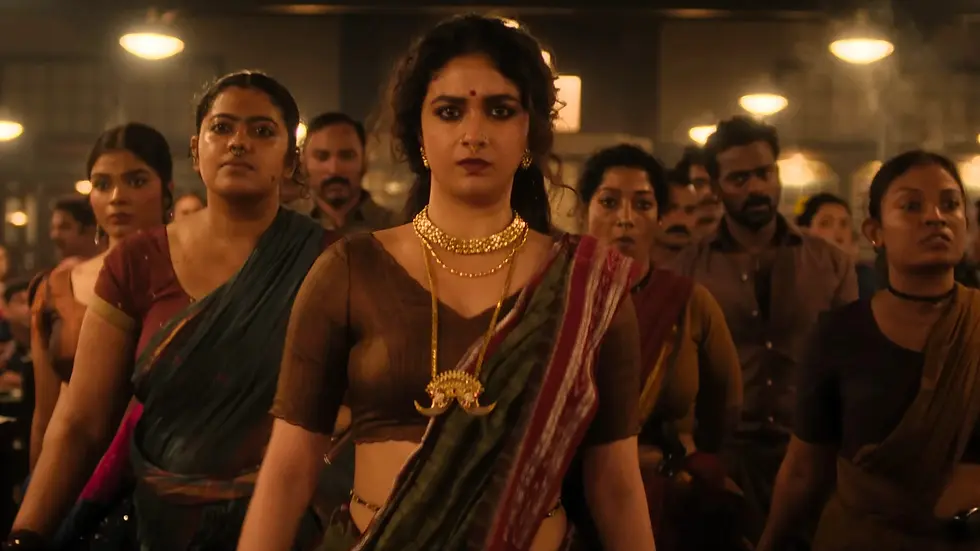
Keerthy Suresh's Bhavani is the production's most consistently praised asset, and she occupies the more interesting position in this struggle. She already possesses authority, along with everything that makes authority inconvenient: relatives, inherited obligations, political enemies and people who expect her to solve their problems. A gangster trying to seize power can make enormous promises. A gangster defending an empire must consider what happens after the shooting stops.
Rudra has the opposite advantage. She doesn't need to maintain the system. She merely needs to locate its weaknesses, exploit its grievances and convince enough people that overthrowing it is worth the consequences. One woman is defending a complicated civilisation. The other has turned up with a very large metaphorical hammer.
The rivalry has attracted divided reactions. NDTV praises the contrasting personalities, while other critics question whether the series develops its characters and political ideas sufficiently. That disagreement points towards the story's greatest missed opportunity. Does Rudra genuinely intend to liberate Pernuru from its traditions, or does she simply want the throne?
Because overthrowing an oppressive ruler is one thing. Discovering that you actually have to govern afterwards is another. Revolutions are wonderful until someone hands you the keys and expects the electricity to remain connected.
If Akka left you wondering whether anyone in organised crime can tell a decent story without making a complete bloody mess of it, our Mafia: Definitive Edition review explores a criminal family that understands loyalty, betrayal and the considerable disadvantages of joining the mob.
A Criminal Empire Dressed for Its Own Coronation
Visually, Akka certainly knows how to make an entrance. The production fills Pernuru with imposing households, extravagant jewellery, period costumes and the unmistakable atmosphere of a society that considers itself terribly important. Gold is everywhere. Apparently, when you've ruled a territory for eight centuries, subtlety becomes something the servants are expected to practise.
Unfortunately, an elaborately decorated kingdom creates expectations. If a production spends considerable effort constructing a criminal civilisation, its rules need to explain why people obey, why they rebel and what happens when someone breaks with tradition. Otherwise, the audience ends up watching an extraordinarily expensive family argument.
Imagine attending a wedding where three enormous families have hated one another for generations. Every guest is wearing enough jewellery to interfere with airport security. Nobody explains what the argument is about, but within twenty minutes somebody's uncle has been stabbed beside the buffet. You're certainly entertained. You haven't the faintest idea why any of it happened.
That's the risk Akka runs when its mythology becomes more elaborate than its storytelling. The setting promises a genuinely different criminal society. The central conflict doesn't always appear equally different.
Five Episodes, Three Hours, and a Rather Complicated Family Dispute
At just over three hours, Akka ought to have enough room to establish its world, develop the rivalry and deliver a satisfying conclusion without requiring viewers to apply for citizenship in Pernuru. Yet its opening episodes have been criticised for crowded exposition, competing relationships and an uncertain balance between political intrigue and revenge.
The series reportedly becomes more effective once those arrangements begin collapsing. The New Indian Express highlights the fourth episode's treatment of Bhavani's weakening authority and the finale's extended action sequence. Other reviewers are far less convinced by the eventual payoff.
There's a difference between a story becoming more exciting and becoming more satisfying. A building collapsing spectacularly may provide wonderful entertainment, but it doesn't automatically make the architecture interesting. And Akka has spent an enormous amount of time showing us its architecture.
The strongest material appears to emerge when political decisions produce personal consequences. Alliances fracture, inherited authority becomes vulnerable, and Bhavani must confront the possibility that the world she was raised to protect might not survive. That's where a gangster story can become special. Violence isn't particularly difficult to write. Give enough people weapons and incompatible ambitions, and eventually somebody will redecorate the walls. Making that violence matter requires understanding what the characters stand to lose.
The ending has also attracted criticism for leaving its central conflict insufficiently resolved. An unresolved ending isn't inherently a failure, but there's a difference between making an audience desperate for another season and making them wonder whether the current one has actually finished.
Verdict: An Extraordinary Kingdom, a Familiar War
Akka has a fascinating premise, impressive production design and a central performance from Keerthy Suresh that has earned substantial critical praise. Yet the critical evidence points towards uneven storytelling, underdeveloped political ideas and a conclusion that struggles to reward the investment.
There's still an audience for this. Anyone drawn to elaborate criminal dynasties, violent power struggles and unusual fictional societies may find plenty to enjoy in Pernuru, particularly as the conflict intensifies. But those hoping for an exceptionally sharp examination of organised criminal authority should lower their expectations.
The most interesting question Akka raises is whether replacing the people who control an oppressive system changes anything about the system itself. It's a question worth an entire gangster saga. It's also considerably more interesting than another three hours of people fighting over who gets the throne.

Still in the mood for criminal conspiracies, terrible decisions and people who absolutely shouldn't be trusted with authority? Explore CRIMENET's Crime Series reviews. We've got more fictional catastrophes waiting, and not all of them involve detectives staring thoughtfully at evidence.
Akka FAQ
What is Akka about?
Akka is a Netflix crime thriller set in Pernuru, a fictional territory ruled by powerful female criminal clans. The story follows Bhavani, an established leader whose authority is threatened by Rudra, a rebellious challenger determined to overturn the existing order.
How many episodes does Akka have?
Akka has five episodes, with a combined running time of approximately three hours. All five episodes were released on October 30, 2026.
Is Akka based on a true story?
No. Akka is a fictional gangster drama featuring an invented matriarchal society, criminal dynasties and a struggle for power.
Is Akka worth watching?
Akka has an unusual premise, striking production design and a widely praised performance from Keerthy Suresh. However, published reviews have criticised its uneven storytelling and underdeveloped political conflict. It's potentially worthwhile for viewers interested in crime dynasties, but expectations should be tempered.
Where can I watch Akka?
Akka is available to stream on Netflix.


Comments