
Aliens vs. Predator (2010) Review: 16 Years Later, Being the Monster Still Beats Being the Poor Bastard It Hunts

Most horror games teach you to fear what might be hiding in the darkness. Aliens vs. Predator lets you crawl onto the ceiling and become somebody else's reason for needing therapy.
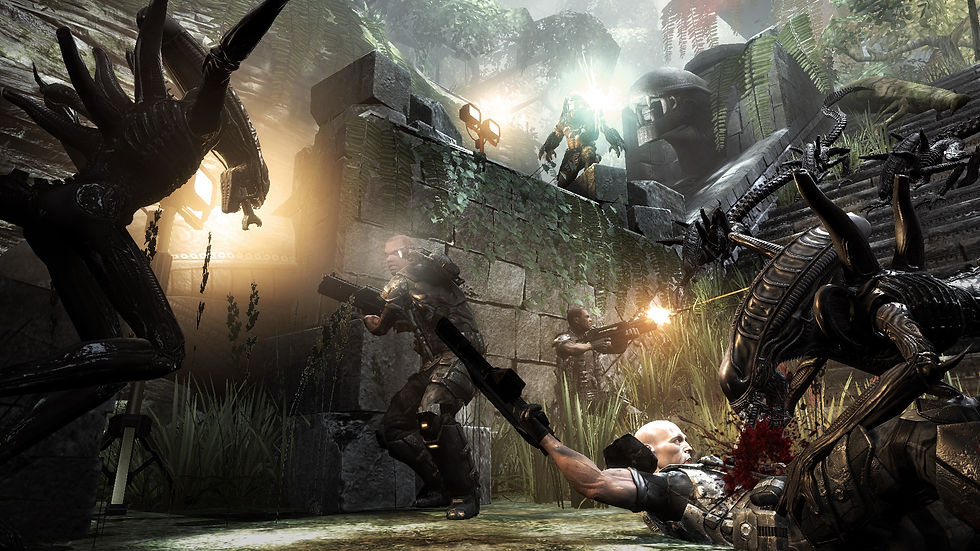
Aliens vs. Predator (2010) is still worth playing in 2026, especially if you've ever wanted to experience the Alien universe from the wrong end of the food chain. Rebellion's sci-fi shooter offers three separate campaigns, allowing you to play as a Colonial Marine, a Predator or a Xenomorph. Each approaches the same conflict differently, and the two monster campaigns remain the biggest reason to give this sixteen-year-old game your attention.
It's also undeniably flawed. The controls can be awkward, the environments repeat, the campaigns are relatively short, and the combat occasionally reduces two of cinema's most terrifying creatures to participants in a rather violent game of rock-paper-scissors. Yet there's a reason its Steam audience has remained considerably more affectionate than the critics who reviewed it in 2010. Beneath the dated mechanics is something genuinely special: a game that understands the appeal of a monster extends beyond being frightened by it. Sometimes you want to be the reason somebody else is frightened.
Enjoy being the thing lurking in the ventilation shaft? See the 10 most popular villain games right now. From Xenomorphs to criminal masterminds, apparently humanity has given us plenty of reasons to change sides.
Three campaigns, three completely different attitudes towards human life
Most Alien games understand their responsibilities. You're a human, you're surrounded by things with far too many teeth, and somebody has apparently decided that sending a handful of employees into a biological catastrophe constitutes an acceptable business strategy. Your job is to survive.
Aliens vs. Predator questions that arrangement. Why should humans always be the protagonists? What makes their continued existence so terribly important? Surely the Xenomorph has plans for the afternoon too, even if those plans primarily involve the inside of somebody's skull.
The Marine is vulnerable and heavily dependent on his equipment. The Predator is a technologically advanced hunter who prefers controlling an encounter before committing to violence. The Alien is an extraordinarily mobile killing machine whose understanding of personal boundaries is practically nonexistent. What makes this interesting is how completely those differences change your understanding of the environment.
A dark ventilation shaft is an obvious threat to a Marine. For an Alien, it's infrastructure. An elevated position that makes a human feel exposed becomes an opportunity for a Predator. A corridor that seems perfectly reasonable when you're holding an assault rifle acquires an entirely different purpose when you're capable of traversing its ceiling. The game doesn't need three completely different worlds to deliver three different experiences. It changes what you are capable of doing within them.

The Marine campaign: You're the least interesting organism in the building
The Marine campaign is the most conventional of the three. You're armed, you're trained, and you're surrounded by enough military hardware to make an American defence contractor spontaneously propose marriage. None of which changes the fundamental problem. You're still human.
Your primary activities involve exploring hostile installations, fighting Xenomorphs, managing ammunition and watching your motion tracker announce that something unpleasant is approaching. The atmosphere relies heavily on darkness, enclosed spaces, ominous sounds and the knowledge that the creatures hunting you don't need permission to use the ceiling.
The motion tracker deserves particular attention because it's such a brilliantly unpleasant invention. In ordinary circumstances, detecting nearby movement would be reassuring. You'd know where the danger was coming from and could prepare accordingly. Here, the device mostly informs you that something wants to kill you without necessarily providing enough information to prevent it.
Imagine installing a burglar alarm that doesn't alert the police, lock the doors or frighten the intruder. It simply announces that Gerald the Burglar has entered your house, is currently approaching the bedroom, and appears to have brought several friends. You'd probably prefer not to know.
That uncertainty is where the Marine experience finds its strength. Contemporary reviews particularly praised the atmosphere of its earlier encounters, when darkness and limited information make the Xenomorphs genuinely threatening. Unfortunately, as the campaign progresses, conventional shooting gradually replaces much of that tension. Combat grows familiar, and the initial terror gives way to eliminating enemies before proceeding to the next objective.
The problem is partly unavoidable. A monster stops being quite so mysterious after you've killed several dozen of its relatives. Your growing competence gradually undermines the atmosphere the game worked so hard to establish. And it's difficult to get terribly excited about holding another firearm when the alternatives include climbing across ceilings and removing somebody's head as a recreational activity.

The Predator campaign: Hunting humans with the technological budget of a small nation
The Predator campaign is where Aliens vs. Predator starts fulfilling a particularly wonderful fantasy. You're no longer stumbling through corridors wondering what might be waiting around the corner. You're the thing everyone should have checked for before entering the building.
Your equipment includes cloaking technology, different vision modes, specialised weapons, wrist blades and the ability to leap between advantageous positions. Distractions allow you to manipulate human enemies, creating opportunities to approach them without immediately attracting attention. The Marine generally wants to eliminate a threat before it reaches him. The Predator wants to decide when the encounter begins in the first place.
Of course, the Predator's technological superiority raises an interesting question. What sort of species develops interstellar travel, optical camouflage, advanced targeting equipment and enough weaponry to reorganise somebody's skeleton, then decides the highest possible use of these achievements is hunting creatures who have barely figured out how to stop arguing over parking spaces?
Imagine humanity finally mastering faster-than-light travel. Scientists announce that we've conquered the impossible, energy companies are preparing to revolutionise civilisation, and medical researchers are discussing the elimination of disease. Then somebody from the government enters the room.
"Excellent work, gentlemen. Now, which of these inventions would help us hunt squirrels?"
A Predator would probably consider this a perfectly respectable allocation of resources.
Underneath the absurdity is an effective gameplay premise. The Predator isn't simply powerful. Its tools encourage you to choose advantageous positions, gather information and decide how to approach a target. Its hunting abilities are especially compelling against humans, while Xenomorph encounters demand more direct combat and reduce some of those elaborate stalking opportunities.
Unfortunately, the game doesn't always give its impressive toolkit enough room to produce genuinely interesting decisions. Combat can become repetitive, and the mechanics occasionally feel less elegant than the creature they're attempting to represent. Still, the fantasy remains strong because you aren't merely defeating enemies. You're hunting them, and Rebellion deserves credit for understanding the difference.

Prefer your monsters with a little more management responsibility? Read our Ghost Keeper review, where you command an army of supernatural horrors and turn haunting innocent civilians into a perfectly respectable career choice.
Playing as the Alien is the game's greatest idea, even when the walls disagree
Forget the gadgets. Forget firearms. Forget the elaborate technology required to make a Predator look impressive. You're a Xenomorph, with claws, teeth, a tail and the ability to traverse surfaces that normal creatures would consider structurally inappropriate.
Instead of approaching rooms through doors, you can use walls and ceilings, exploit elevated routes, ambush humans and attack from directions they aren't equipped to monitor comfortably. This changes the most basic assumptions of first-person gameplay.
Most shooters teach you to think horizontally. You enter a room, identify enemies, locate cover and deal with whatever is standing in front of you. Even when verticality exists, it's normally restricted to stairs, platforms and the occasional rooftop. The Alien doesn't particularly care about these architectural conventions.
A room becomes a volume of space containing several possible routes, and the humans wandering around inside it are generally rather attached to the idea that gravity applies to everyone. It doesn't. At least, not equally.
Consider a perfectly ordinary human security guard. He's been given a uniform, a weapon and presumably some form of workplace safety briefing. He's responsible for protecting an installation against hostile creatures. He checks the entrance. Nothing. The corridor. Nothing. Behind the machinery. Still nothing. Excellent. Everything appears to be under control.
Unfortunately, nobody mentioned that the creature he's looking for has been treating the ceiling as a perfectly serviceable pavement. You can see why the Alien universe has such difficulty recruiting reliable staff.
The movement system is crucial to this fantasy, but it's also one of the game's most divisive mechanics. Community players have repeatedly criticised disorienting wall transitions and awkward controls. Moving across unusual surfaces sounds liberating until the camera orientation makes it difficult to understand where you're actually going.
That's particularly frustrating because movement is central to the Alien's identity. A clumsy reload animation might briefly irritate a Marine. Clumsy traversal actively interferes with what makes playing as a Xenomorph interesting in the first place. Its close-range attacks and gruesome finishing moves are suitably horrible, although melee encounters can become predictable.
Still, the underlying achievement deserves recognition. The Alien campaign doesn't simply give you a human character with an unusual appearance and a different weapon. It asks you to perceive the world differently. That alone makes it worth experiencing.
Apparently even extraterrestrial murder requires proper timing
Aliens vs. Predator uses a melee system built around light and heavy attacks, blocking and countering. Understanding these interactions becomes important when fighting enemies capable of responding to your attacks.
There's a reasonable argument for this. Without limitations, two species possessing extraordinary physical abilities could simply annihilate everything in front of them. The game needs mechanics that prevent every encounter from becoming an automatic victory. Fair enough.
The trouble is that once players understand the effective responses, some fights become exercises in executing the correct sequence rather than improvising with the terrifying abilities of an extraterrestrial predator. There's a strange comedy in watching a creature capable of tearing someone apart being temporarily reduced to a dispute over whether somebody pressed the appropriate counterattack button.
Imagine explaining that to a Xenomorph.
"Unfortunately, your attempted disembowelment has been unsuccessful."
Why?
"Your opponent performed a successful defensive action."
I have claws capable of tearing through flesh.
"Yes, but have you considered waiting for the correct opening?"
The creature would probably eat the instructor. And frankly, I wouldn't blame it.
The mechanics aren't bad simply because they impose rules on powerful characters. Good combat systems need limitations. The weakness emerges when players become more conscious of those rules than the fantasy they're supposed to support. A Predator encounter should feel like an intelligent hunter exploiting an opportunity. An Alien encounter should feel like an agile creature overwhelming its prey. When the combat doesn't deliver that, the illusion gives way to familiar mechanical repetition.

The executions are spectacular. Until you've watched enough people lose their heads.
Few aspects communicate the game's attitude more clearly than its finishing moves. The Predator collects trophies. The Alien dispatches enemies through elaborate, gruesome attacks. Both campaigns embrace the cinematic brutality associated with their respective franchises, and that's exactly what they should do. Sanitising that violence would undermine their identity.
Unfortunately, spectacle has a lifespan. The first elaborate execution can be shocking. The fifth might remain entertaining. Eventually, repeated animations risk becoming less about the excitement of a particularly vicious kill and more about waiting for the game to return control.
It's the difference between witnessing something horrifying and sitting through the same workplace presentation for the seventh time. Yes, Deborah, we've all seen the head come off. Can we please continue?
The animations remain visually impressive, but their repetition affects pacing. A game can make violence sufficiently elaborate that it temporarily stops being satisfying to perform. Yet removing those animations would also remove some of its personality. Aliens vs. Predator is occasionally trapped by its own enthusiasm for being Aliens vs. Predator.
Three perspectives, one increasingly familiar collection of corridors
The campaigns share environments and narrative elements, producing an interesting disagreement between critics and players. Revisiting familiar locations can feel like a shortcut, particularly when the campaigns are already relatively brief. You've explored these environments before, and returning doesn't necessarily offer much excitement.
On the other hand, there's something clever about experiencing related spaces from different positions within the conflict. The Marine sees a hostile installation. The Predator sees potential hunting territory. The Alien sees pathways and prey. The location remains familiar, but the priorities change.
Both arguments can be right. Reusing environments can strengthen the impression that three separate stories exist within one coherent world. It can also become repetitive when the new campaign doesn't transform the experience enough to justify returning there.
Community criticism has also highlighted the limited interaction between the campaigns and the desire for stronger narrative connections. There's an obvious appeal to seeing the consequences of one character's actions from another species' perspective. The game gestures towards that possibility without developing everything it could have offered, which is frustrating because the foundation is already there.
So why do players still love it?
Aliens vs. Predator arrived in 2010 to mixed critical reception. Its Metacritic score sits at 68, with contemporary reviewers criticising awkward controls, repetition and uneven campaign quality. Yet its Steam audience has remained considerably more positive, with a Very Positive overall rating and years of discussions praising the experience.
That doesn't mean the critics were wrong. It suggests they were measuring something that mattered differently to many of the players who kept returning.
A critic evaluating the complete package has every reason to object to dated mechanics and underdeveloped campaign elements. But somebody who specifically wants to control a Xenomorph might value the ability to crawl across ceilings and hunt unsuspecting humans more highly than perfectly polished combat. Likewise, a Predator enthusiast may tolerate mechanical awkwardness because so few games offer that particular hunting fantasy.
Some games remain relevant because they were exceptionally polished. Others because they invented something influential. A few survive because, despite their imperfections, they let players do something that remains surprisingly difficult to find elsewhere.
Aliens vs. Predator belongs largely in that last category. Its greatest strength isn't that it perfected three genres simultaneously. It didn't. It's that the playable species genuinely change your relationship with danger.
Does Aliens vs. Predator work on modern PCs in 2026?
The Steam version remains available, although modern PC compatibility varies. Players have reported DirectX-related launch problems, crashes and display issues, while others report running the game without significant modification. There isn't enough consistent evidence to declare that every modern PC will run it flawlessly or that Windows 11 universally breaks it.
If you encounter problems, check the Steam discussions for reports matching your hardware and launch configuration. Alternative DirectX launch modes have helped some players, but no workaround is guaranteed.
Multiplayer deserves similar caution. The game supports several modes, but community reports describe difficulty finding public matches. Dedicated groups still arrange sessions, so multiplayer isn't necessarily inaccessible, but buying the game specifically for reliable matchmaking would be a gamble.
Buy it primarily for its campaigns and consider multiplayer a bonus. The single-player experience is also relatively short, making this an easier recommendation during a substantial Steam discount than at a price competing with newer shooters.
Final verdict: Still one of gaming's most entertaining identity crises
Aliens vs. Predator (2010) has three excellent ideas and an occasionally questionable understanding of how to execute them. The Marine delivers atmospheric survival horror before becoming increasingly conventional. The Predator offers an appealing hunting fantasy constrained by repetitive combat. The Alien is wonderfully distinctive, even when its ambitious movement system makes navigating a wall unnecessarily complicated.
None of those weaknesses disappeared because sixteen years passed. But neither did the game's central appeal.
For players expecting a technically polished modern shooter, deep storytelling or a thriving multiplayer community, there are better choices. For anyone who loves playable monsters, Predator hunting and the Alien universe, however, Aliens vs. Predator remains an easy recommendation at the right price.
Most horror games spend their entire existence convincing you that the monster is dangerous. Aliens vs. Predator gives you the monster, lets you climb onto the ceiling, and leaves the terrified security guards to reconsider their employment contracts.
Frankly, more horror games should have the decency to offer that option.

Still haven't satisfied your appetite for terrible decisions and things with far too many teeth? Explore CRIMENET's horror games, from desperate survival to playing the monster yourself. Humanity's survival remains entirely optional.
Aliens vs. Predator (2010) FAQ
Is Aliens vs. Predator still worth playing in 2026?
Yes, especially for the Alien and Predator campaigns. The controls and combat have aged, but few games let you experience horror from three such different perspectives. It's particularly worth grabbing during a Steam sale.
Can you play as both the Alien and Predator?
Yes. Aliens vs. Predator features three separate single-player campaigns: Colonial Marine, Predator and Xenomorph. Each has unique abilities, movement mechanics and combat styles.
How long does Aliens vs. Predator take to beat?
Expect approximately 8–10 hours to complete all three campaigns, depending on difficulty and playstyle. Replaying missions and exploring multiplayer can extend that.
Does Aliens vs. Predator still have multiplayer in 2026?
Yes, but finding matches can be difficult. The multiplayer community is relatively small, and organised sessions may be more reliable than public matchmaking. Don't buy it expecting consistently populated servers.
Does Aliens vs. Predator work on Windows 11?
It can, but compatibility varies. Some players report crashes, DirectX errors or display problems, while others run it successfully. Trying an alternative DirectX launch option may help, although it isn't a guaranteed fix.
Which Aliens vs. Predator campaign is the best?
The Alien and Predator campaigns are the strongest reasons to play. Predator offers tactical hunting and advanced weaponry, while Alien delivers fast movement, wall-crawling and gruesome ambushes. The Marine campaign is better suited to players who prefer traditional survival horror.




Comments