

S.T.A.L.K.E.R. 2: Cost of Hope Is Here, and the Zone Wants You Dead Again

Updated: Aug 27
Quick Verdict
S.T.A.L.K.E.R. 2: Cost of Hope is worth returning to the Zone for. It delivers a substantial 15–20+ hour story, two excellent new regions, meaningful Duty-versus-Freedom choices, some vicious horror sequences and mission design that frequently improves on the base game. A week after launch, Steam has settled at Very Positive, with 82% positive across more than 800 reviews, so the early promise has survived contact with the paying public.
But there is an important catch.
Cost of Hope launched beside the enormous free Update 2.0, which improved the underlying game. So no, the DLC does not get to burst into the room wearing medals because S.T.A.L.K.E.R. 2 suddenly runs better, shoots better and behaves less like its AI was raised by raccoons.
Judge the expansion on what it adds, though, and there's plenty worth paying for: strong new environments, a proper faction story, excellent horror, ambitious mission scenarios and enough content to qualify as an expansion rather than a weapons pack wearing its father's suit.
Verdict: Buy it if you already enjoy S.T.A.L.K.E.R. 2. If the original game's enormous walking distances and deliberate friction drove you insane, Cost of Hope has not discovered the bicycle.
If radioactive misery is your preferred flavour of entertainment, our S.T.A.L.K.E.R. 2 coverage goes deeper into the Zone, its monsters and whether surviving Chornobyl has finally stopped requiring tolerance for industrial quantities of jank.
What Cost of Hope Actually Adds
Released on August 20, Cost of Hope is the first major story expansion for S.T.A.L.K.E.R. 2: Heart of Chornobyl.
You remain Skif, but this time Duty and Freedom take centre stage. Their ideological disagreement concerns what humanity should do about the Zone, although after decades of S.T.A.L.K.E.R. history both factions remain surprisingly committed to presenting their philosophical arguments at approximately 700 rounds per minute.
The campaign introduces two major regions, including the Iron Forest and the long-awaited territory surrounding the Chornobyl Nuclear Power Plant. The story branches according to faction decisions and supports two endings. Independent completed playthroughs put the main campaign around 15 to 21 hours, with optional content extending that further.
That's important because this isn't three missions and a rifle called Vladimir.
There's a proper campaign here.
The familiar S.T.A.L.K.E.R. machinery remains underneath it. You explore hostile wilderness and abandoned facilities, scavenge supplies, maintain equipment, fight humans and mutants, navigate anomalies and repeatedly enter buildings where every functioning mammalian instinct is screaming DO NOT GO IN THERE because somebody mentioned there might be ammunition downstairs.
And Cost of Hope understands exactly why that works.
The Zone Is Horrible Again. Excellent.
The best parts aren't simply more open-world errands.
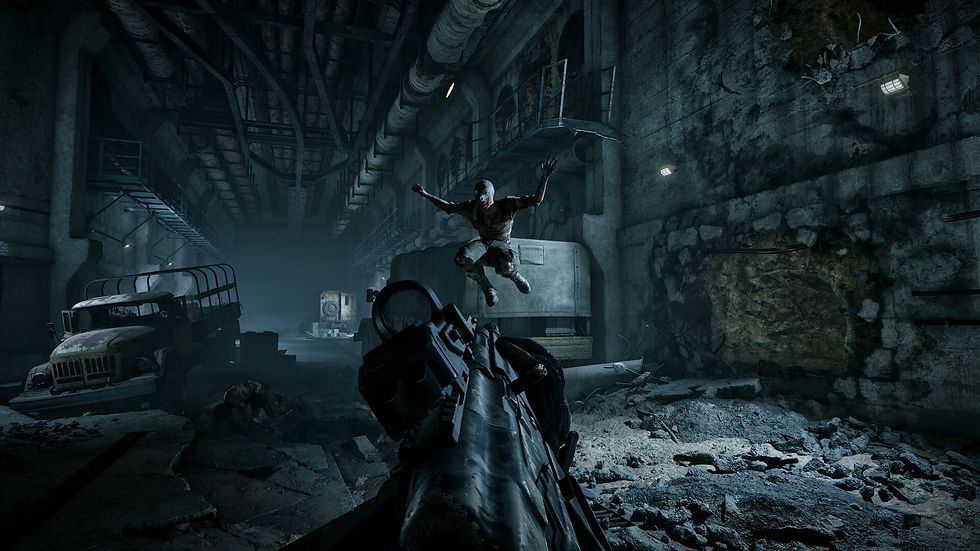
Individual mission areas become more deliberately constructed spaces, with interconnected routes, locked areas, environmental puzzles and hazards that turn exploration into something closer to compact horror levels inside the larger Zone.
One area distorts perception. Another makes navigation itself part of the danger. Underground sections strip away the comfort of open terrain. Psychological sequences manipulate environments instead of merely spawning another angry mutant directly behind Skif's kidneys. Later missions continue introducing unusual hazards rather than exhausting every trick during the opening hours.
This is where Cost of Hope earns its money.
S.T.A.L.K.E.R. has always been most frightening when nothing is happening yet.
An abandoned building.
A noise underneath it.
An anomaly blocking the obvious route.
Three magazines remaining.
A suspiciously valuable-looking door.
Then curiosity takes control of the steering wheel and drives common sense directly into a ditch.
The expansion understands that relationship beautifully. Its best horror comes from convincing you to voluntarily proceed into increasingly terrible situations because there might be something useful at the other end.
Congratulations. You have been murdered by loot again.
Want another horror game where entering the building is obviously a catastrophic decision? Read our Servant of the Lake coverage and discover an entirely different method of having your survival instincts ignored by videogames.
Duty, Freedom and Everyone's Terrible Ideas
The faction conflict gives all that wandering a stronger narrative spine.
Duty believes the Zone needs controlling. Freedom has very different ideas. Skif gets pulled between them, and your allegiance influences where the story eventually goes.
That works particularly well in S.T.A.L.K.E.R. because the universe rarely needs somebody stroking a cat while explaining Phase Three of the Evil Plan.
Everybody has motives.
Everybody has principles.
Everybody also owns military hardware and possesses the conflict-resolution abilities of two divorced men fighting over a lawnmower.
The result is morally dirtier and consequently more interesting than simply choosing between Good Faction and People Who Have Decorated Their Headquarters With Skulls.
The new environments help enormously. Full-game reviews consistently single out the new areas and mission spaces as some of the expansion's strongest material, with the later campaign around the reactor particularly effective.
There's variety too. Cost of Hope doesn't merely send you through twenty hours of identical mutant extermination. Its main missions repeatedly change the environmental problem or scenario.
The optional material fares worse. Side missions can fall back on familiar jobs involving missing stalkers or mutant removal, and that exposes one of S.T.A.L.K.E.R. 2's oldest problems.
Sometimes the Zone feels like an unknowable supernatural ecosystem.
Sometimes it feels like somebody has posted KILL 6 THINGS, RETURN TO SERGEI on the village noticeboard.
Update 2.0 Does Not Come With Your Receipt
Now we need to separate two bodies before somebody accidentally identifies the wrong corpse.
Cost of Hope launched alongside Update 2.0, a free overhaul available to owners of the base game.
That update substantially improves the underlying S.T.A.L.K.E.R. 2 experience, including its technology and simulation. Consequently, the noticeably healthier game surrounding the expansion cannot simply be credited to your €29.99 DLC purchase.
This matters because S.T.A.L.K.E.R. 2 launched in 2024 with enough technical baggage to require its own carousel at the airport.
The current game is in much better shape.
Completed PC playthroughs show far greater stability, with isolated crashes and minor visual oddities rather than the relentless technical problems associated with the original launch. Steam's current 82% positive reception for the expansion reinforces that this is no longer merely reviewers being optimistic during the honeymoon period.
Excellent.
But Update 2.0 deserves Update 2.0's applause.
The reason to buy Cost of Hope is the campaign, regions, faction conflict, new encounters and bespoke mission design.
Reviewing the DLC based on the free update would be like awarding a restaurant five stars because the council finally filled the pothole outside.
Unfortunately, Walking Remains Free
The biggest surviving problem is almost comically mundane.
You walk.
Christ, do you walk.
S.T.A.L.K.E.R. 2's limited fast travel remains intact, and Cost of Hope eventually sends Skif across substantial distances. The Zone is magnificent when you're exploring because you chose to. It's considerably less magnificent when you're crossing half of Ukraine because a mission objective has apparently been filed by a man who personally owns a shoe company.
Full-game reviews repeatedly identify this travel burden as a source of pacing problems. One mission can deliver an excellent facility, puzzle or horror sequence, then reward you with another substantial trek through countryside you've already admired from every conceivable angle.
Yes, the isolation matters.
Yes, unrestricted fast travel could damage the vulnerability that makes S.T.A.L.K.E.R. work.
There is nevertheless a point where immersion becomes commuting.
Cost of Hope occasionally marches straight past it carrying a backpack full of sausages.
Combat has rougher moments too. Mutant hitboxes can behave inconsistently, and some of the new creatures are more irritating than terrifying. The Pseudogiant can trap Skif in brutal attack patterns, while the final boss has drawn particular criticism for being poorly designed rather than satisfyingly difficult.
These aren't expansion-destroying problems.
They are reminders that this is still S.T.A.L.K.E.R.
The Zone has received extensive renovations.
Someone forgot to remove all the exposed wiring.

This Week in CRIME is where we collect the crime games worth robbing, horror worth screaming at and industry disasters too magnificent to leave unattended. One briefing. All the week’s best bad decisions.
Is Cost of Hope Worth €29.99?
For existing S.T.A.L.K.E.R. 2 players, yes.
The campaign is long enough to justify calling this a genuine expansion, its best environments are excellent, the Duty-Freedom storyline gives it an identity beyond "more Zone," and the horror benefits from more deliberate mission design than another procession of open-world firefights.
The Steam consensus has also matured considerably since launch. More than 800 reviews with an 82% positive rating isn't unanimous worship, but it is strong evidence that the expansion's appeal survived beyond the review-key honeymoon.
If you abandoned the base game because of its catastrophic original technical state, however, install Update 2.0 before buying anything. See how the current game feels. Many of the improvements making S.T.A.L.K.E.R. 2 substantially more attractive in August 2026 are free.
If you hated the underlying design rather than the bugs, be more cautious. Cost of Hope doesn't abolish long-distance travel, inventory management, equipment maintenance or the deliberate friction of surviving the Zone.
And it shouldn't.
It just occasionally confuses deliberate friction with sending you to Belgium on foot.
Verdict
Cost of Hope doesn't reinvent S.T.A.L.K.E.R. 2.
It gives the game some of the strongest reasons yet to endure it.
Its new regions are atmospheric, its main missions become impressively varied, the faction conflict belongs naturally in this universe, and the horror remembers that anticipation is far nastier than throwing another monster through a window.
There are still irritating mutants. Still awkward moments. Still too much walking. Still enough residual S.T.A.L.K.E.R. weirdness that perfection remains somewhere behind an anomaly field without a map marker.
But the uncertainty surrounding the launch has gone.
Cost of Hope is a proper expansion, and for people who already love the Zone, it's worth the return ticket.
Just don't expect an actual return ticket.
Apparently you're fucking walking.
FAQ
Is S.T.A.L.K.E.R. 2: Cost of Hope worth buying?
Yes, if you already enjoy S.T.A.L.K.E.R. 2. The expansion adds a substantial new campaign, two major regions, faction choices and some excellent survival-horror missions. If you hated the base game's fundamental design, this won't perform an exorcism.
How long is Cost of Hope?
Expect roughly 15-20+ hours for the main campaign, with optional content potentially pushing that higher.
Do I need Cost of Hope to get Update 2.0?
No. Update 2.0 is a free base-game update. Don't accidentally pay the DLC for work it didn't do.
Is Cost of Hope better technically than S.T.A.L.K.E.R. 2 was at launch?
Considerably. The current game is far more stable than the infamous 2024 launch, although occasional bugs, visual issues and performance hiccups remain.
Does Cost of Hope have multiple endings?
Yes. The Duty-versus-Freedom storyline includes choices that can lead to two endings.
Is Cost of Hope scary?
Yes. Its strongest sequences use hostile environments, anomalies, underground spaces and psychological tricks rather than relying entirely on monsters attempting to enter Skif through his trousers.


Comments